




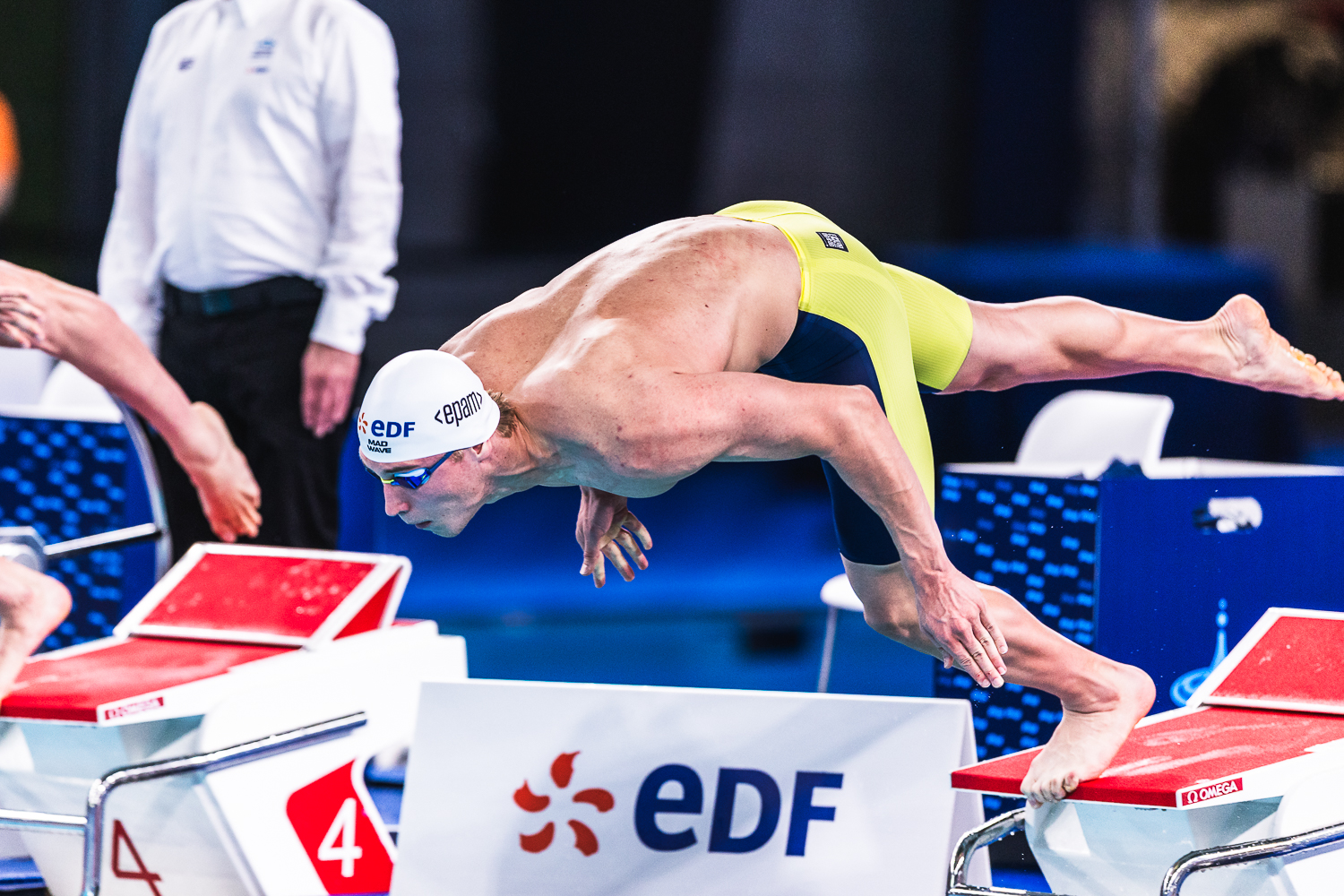
The 22-year-old Russian broke the short-course 50m butterfly mark in Tashkent and had already tied the 100m freestyle record in Baku.
Egor Kornev completed the men’s 50m butterfly triple crown at the World Aquatics World Cup in Astana, Kazakhstan, on Saturday, 17 October, extending a short-course sprint run that had already included a world record in the same event and a share of the 100m freestyle world record.
The 22-year-old Russian won the Astana final in 21.82 seconds, ahead of Tzen Wei Teong of Singapore in 22.03 and Grigori Pekarski of Belarus in 22.16. The time was more than half a second slower than the mark Kornev had set one week earlier, but it was enough to secure his first triple crown of the series.
Kornev’s defining swim came in Tashkent, Uzbekistan, on Saturday, 10 October, when he clocked 21.28 in the short-course 50m butterfly. That was the fastest time in history over the distance in a 25-metre pool and improved by 0.04 seconds the world record set by Switzerland’s Noe Ponti at the 2024 World Short Course Championships.
That performance followed another major short-course result eight days earlier. At the first World Cup stop in Baku, Azerbaijan, on Friday, 2 October, Kornev swam 44.84 in the 100m freestyle, matching the world record held by Kyle Chalmers since 2021.
Speed across the sprint programme
The World Cup series was held in short-course pools, rather than the 50-metre long-course pools used at the Olympic Games. Even with that distinction, Kornev’s sequence across Baku, Tashkent and Astana has stood out for its range: butterfly, freestyle and backstroke all produced either record-level swims or podium results.
In Baku, Kornev also set a World Cup record in the 50m backstroke with 22.23. That mark lasted one week before Pieter Coetze lowered the world record to 22.09 in Tashkent, breaking Kliment Kolesnikov’s 22.11 and taking down Kornev’s World Cup record. Kornev was second in that final in 22.29, with Pavel Samusenko third in 22.35.
The 100m freestyle in Tashkent brought another close test rather than another record. Kornev and Cameron McEvoy touched together in 45.24, with Ivan Girev third in 46.51. McEvoy led through halfway in 21.42, with Kornev at 21.68, before Kornev closed the gap over the final length.
In Astana, Kornev’s 50m butterfly victory also briefly shifted the overall World Cup standings. After that race, he led Lucas Henveaux by 6.7 points, with Coetze still able to challenge later in the session through the men’s 50m backstroke.
Long-course form adds context
Kornev’s short-course run came after a long-course season in which he became the third-fastest man in history in the 100m freestyle and 50m butterfly, and the fifth-fastest ever in the 50m freestyle.
At the European Championships in August, he won gold in the 50m butterfly and silver in both the 50m and 100m freestyle. In his long-course World Championships debut in 2025, he placed fifth in the 50m and 100m freestyle.
The 50m butterfly will make its Olympic debut at Los Angeles 2028, alongside the 50m backstroke and 50m breaststroke. Kornev’s World Cup series does not change the difference between short-course and long-course racing, but it adds a clear marker to the sprint landscape with two seasons still to run before those events enter the Olympic programme.

Journalist
James Michael Carter
James Michael Carter has written for the publication since 2013. He sets every result inside a wider trend — a season, a run, a trajectory — and stays careful with his wording. Sharp verdicts are not his register.

Most read today
- 1
- 2
- 3
Latest
- 16:11
- 16:08
- 15:35
- 15:31
- 15:29